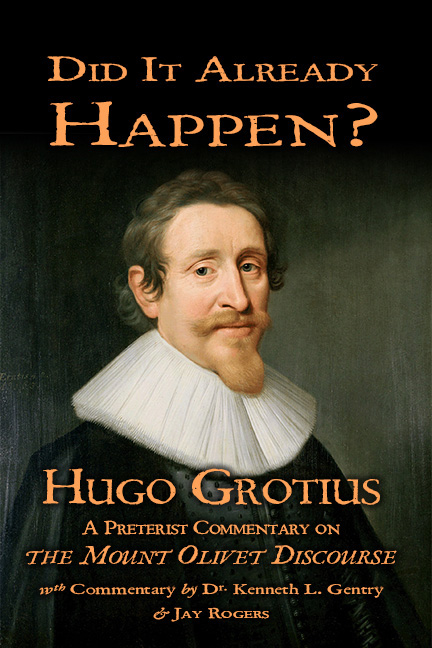
This work introduces the first English translation of Hugo Grotius’ 17th-century commentary on the Mount Olivet Discourse (Matthew 24–25). Grotius, a Dutch polymath and legal scholar, pioneered a historical-philological method that interpreted many biblical prophecies as fulfilled in the destruction of Jerusalem in AD 70.
This perspective — commonly known as preterism — argues that Jesus’ warnings about “the coming” often referred to the manifestation of His kingdom through historical events, rather than exclusively to the final end of the world.
While Grotius maintained orthodox belief in a future resurrection and final judgment, his work grounds Scripture in its original historical context through careful linguistic and historical analysis. This publication seeks to recover his influential yet neglected voice for modern readers by overcoming the barrier of his original Neo-Latin text.
Through this approach, Grotius offers a framework that distinguishes between:
- the historical judgment of Israel (AD 70)
- and the ultimate judgment of humanity
How Grotius Linked Matthew 24 to AD 70
Grotius interpreted Matthew 24 not as a distant futuristic prophecy, but as a structured response rooted in first-century historical events.
1. The Three-Question Framework
In Matthew 24:3, the disciples ask three distinct questions:
- “When will these things be?”
- “What will be the sign of your coming?”
- “And of the end of the age?”
Grotius argues that Jesus answers each separately:
- Question 1: The destruction of Jerusalem (fulfilled in AD 70)
- Question 2: The Parousia as the global expansion of Christ’s kingdom
- Question 3: The final judgment at the end of the age
“Generation” (genea) refers strictly to those living at the time—many of whom witnessed the fall of Jerusalem.
3. Historical Confirmation via Josephus
Grotius relies heavily on first-century historian Josephus to demonstrate fulfillment:
- False Messiahs: Theudas, the Egyptian, Bar Kokhba
- Abomination of Desolation: Roman standards set up near Jerusalem
- Great Tribulation: Famine, civil war, and slaughter during the siege
- Shortened Days: Siege ended rapidly (~6 months), preventing total annihilation
4. Symbolic Prophetic Language
Grotius interprets cosmic imagery as symbolic:
- Darkened sun and moon: Jewish political powers
- Coming on the clouds: Divine judgment language (cf. prophetic tradition)
- Typology: AD 70 serves as a pattern of final judgment
Which Parts Refer to the Future?
Grotius identifies a decisive shift at Matthew 24:36:
“But concerning that day and hour no one knows…”
This marks the transition from historical fulfillment to future expectation.
Key Distinctions
- Verses 4–35 → Predictable, sign-based, fulfilled in AD 70
- Verse 36 onward → Unknown timing, future final judgment
The “Great Divide” at Verse 36
Before verse 36:- Signs are given
- Events are observable
- Timing is unknown
- Emphasis shifts to watchfulness
Matthew 25 and Final Judgment
Grotius assigns all of Matthew 25 to the future:
- Parable of the Ten Virgins
- Parable of the Talents
- Sheep and Goats Judgment
These describe the final, universal judgment and eternal recompense.
Verse-by-Verse Overview (Condensed)
Matthew 24:1–22 — Jerusalem’s Fall
- Temple destruction predicted
- Wars, famines, earthquakes (historical events)
- Persecution under Nero
- Gospel spread across the known world
- Abomination = Roman standards
- Flight to mountains = Christians fleeing to Pella
- Great Tribulation = siege horrors
Matthew 24:23–31 — The Parousia
- False Christs continue post-AD 70
- “Coming” = global, non-visible kingdom expansion
- Lightning imagery = universal spread
- Cosmic signs = symbolic judgment language
- AD 70 = “image and pledge” of final judgment
Matthew 24:32–35 — Imminence
- Fig tree analogy
- “This generation” fulfilled literally
- Certainty of Christ’s words emphasized
Matthew 24:36–51 — The Final Shift
- Unknown day and hour
- Days of Noah analogy
- Sudden separation (taken/left)
- Faithful vs. unfaithful servants
Matthew 25 — Final Judgment
- Virgins → readiness
- Talents → stewardship
- Sheep and goats → eternal judgment
Overall Map, Scope, and Structure
| Section | Focus | Nature |
| 24:4–22 | Destruction of Jerusalem | Historical (AD 70) |
| 24:23–31 | Parousia | Ongoing kingdom expansion |
| 24:36–25:46 | End of the Age | Future final judgment |
Scope
Grotius is:- Preterist in Matthew 24:1–35
- Futurist in Matthew 24:36–25:46
Sequence
- Initial signs
- Fall of Jerusalem
- Expansion of Christ’s kingdom
- Final judgment
Structural Key: Typology
The destruction of Jerusalem is not the end—but a pattern:
A historical “image and pledge” of the final global judgment.
Conclusion
Grotius’ interpretation represents a groundbreaking synthesis:
- Faithful to historical context
- Grounded in linguistic precision
- Balanced between fulfilled prophecy and future hope
By recovering his work, modern readers gain a powerful interpretive framework—one that clarifies difficult passages like Matthew 24 while preserving both historical fulfillment and eschatological expectation.